
×
Talk to us
+44-987-65-4321
Mail Us:
support@gmail.com
×


Start Your Conversation
Reach us anytime, let’s design your dream together.
Location Address:
109/110, 1st Floor, Confident Square Mall, Dommasandra, Yamare, Sarjapura Road, Bangalore - 562125
Need help? Call Us:
+91 636 231 3032
Just Mail Us:
vastuvedainterior@gmail.com
×
Mail Us:
support@gmail.com
Talk to us
+44-987-65-4321
Mail Us:
support@gmail.com
×
Start Your Conversation
Reach us anytime, let’s design your dream together.
Location Address:
109/110, 1st Floor, Confident Square Mall, Dommasandra, Yamare, Sarjapura Road, Bangalore - 562125
Need help? Call Us:
+91 636 231 3032
Just Mail Us:
vastuvedainterior@gmail.com
×
Mail Us:
support@gmail.com
Design Guide
BWP vs HDHMR: Which Material Should You Choose for Your Bangalore Home?
Published by Vastu Veda Interiors · Bengaluru, India
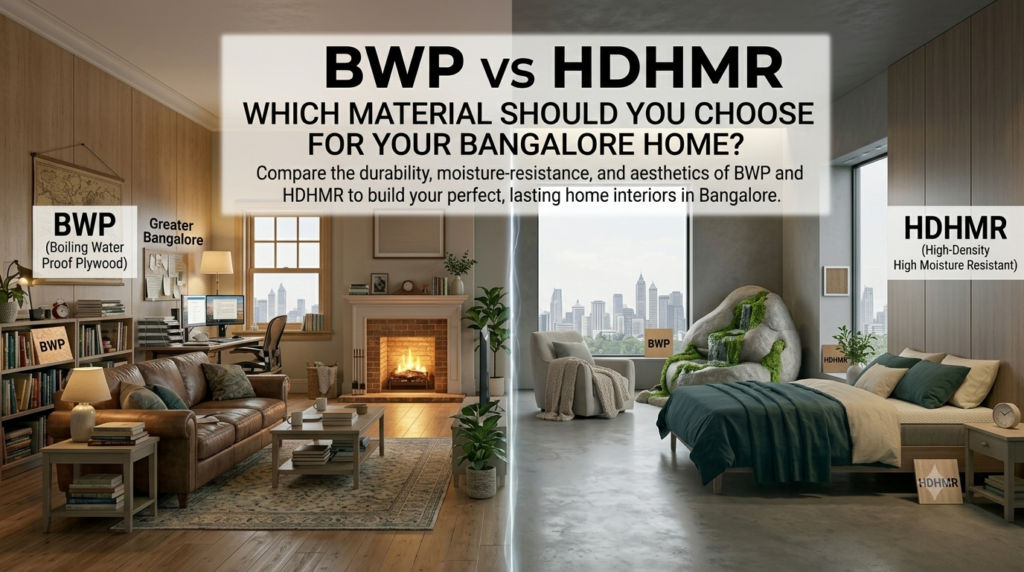
When evaluating interior design proposals, homeowners are often presented with technical jargon—most notably BWP Marine Plywood and HDHMR Board. Misinterpreting these core substrates can lead to sagging wardrobe doors, swollen kitchen cabinets, or unexpected budget inflation down the line.
Choosing the right material for the right application is the secret to a durable, beautiful interior.
This technical guide offers a clear, direct comparison between BWP (Boiling Water Proof) Marine Plywood and HDHMR (High-Density High-Moisture Resistance) boards, providing actionable recommendations for every room in your home.
1. Understanding the Substrates
BWP Marine Plywood (IS 710 Standard)
Constructed by cross-bonding thin sheets of natural wood veneers under high pressure using synthetic Phenol Formaldehyde (PF) resin.
- Structural Mechanics: The alternating 90-degree grain pattern creates exceptional tensile strength, making it ideal for heavy structural loads.
- Water Performance: Engineered to withstand prolonged boiling water exposure (tested up to 72 hours of continuous boiling) without delaminating or losing structural bonding.
Best Characteristic: High load-bearing resilience and immunity to prolonged standing water.
HDHMR Board (High-Density High-Moisture Resistance)
Manufactured by compressing refined hardwood timber fibers mixed with specialized moisture-resistant synthetic resins under extreme density (exceeding).
- Structural Mechanics: Lacks natural wood grain direction, producing a completely homogeneous, solid internal composition that cuts cleanly without chipping.
- Water Performance: Resists high air humidity, ambient steam, and surface spills, though extended immersion in standing water can cause edge swelling over time if edges are unsealed.
Best Characteristic: Perfectly flat, non-warping surface consistency ideal for precision routing and high-end paint finishes.
2. Technical Comparison Matrix
| Property / Feature | BWP Marine Plywood (IS 710) | HDHMR Board |
|---|---|---|
| Density & Core Composition | (Natural wood veneers) | Exceeds (Compressed hardwood fibers) |
| Water & Moisture Resistance | Superior: Handles direct water contact, plumbing leaks, and standing water. | Moderate to High: Resists ambient steam and humidity; vulnerable to pooling water if unsealed. |
| Surface Smoothness & Finish | Shows mild natural veneer texture; requires sanding/filling before painting. | Flawless: Ultra-smooth surface ideal for direct PU paint, thin acrylic, or high-gloss laminates. |
| Bending & Warping Resistance | Moderate risk in long, thin vertical panels (e.g., tall wardrobe doors). | Minimal: Stays completely flat and straight across tall vertical spans due to uniform density. |
| Termite & Borer Resistance | Requires chemical dipping/treatment (BWR/BWP certified). | High: Dense resin composition and fiber structure discourage pest penetration naturally. |
| Screw-Holding Capacity | Excellent along face and edges across repeated adjustments. | High on face; requires precise pilot drilling along edges to avoid splitting. |
| Relative Investment Level | Premium: per sq. ft. | Value-Engineered: per sq. ft. (15–25% overall savings). |
BWP Under-Sink Base Units
HDHMR Full-Height Shutters
CNC Jali & Fluted Panelling
3. Recommended Hybrid Material Allocation Strategy
To maximize performance, longevity, and budget efficiency, the smartest approach is a hybrid specification strategy—using Marine Plywood where water exposure and heavy load capacity matter most, and HDHMR where surface precision, tall spans, and sleek finishes dominate.
A. Kitchens & Wet Utility Areas
- Under-Sink Cabinets & Base Units: BWP Marine Plywood is non-negotiable here to protect against hidden plumbing leaks, drainage backup, or continuous moisture under sink countertops.
- Overhead Cabinets & Loft Shutters: HDHMR works exceptionally well for upper wall units exposed to cooking steam, offering lightweight, flat shutter surfaces.
B. Wardrobes & Bedroom Storage
- Full-Height Wardrobe Shutters: HDHMR is strongly preferred over plywood for tall doors because its uniform density resists warping, ensuring doors align evenly over time.
- Internal Carcase & Shelving: Both materials perform well; plywood provides high horizontal load capacity for heavy storage boxes, while HDHMR offers a clean internal finish for clothing racks.
C. Living Room Entertainment Units & Accent Panelling
- CNC Jali Work & Router Designs: HDHMR cuts cleanly without frayed edges, making it ideal for detailed geometric patterns, TV back-panels, acoustic grooved panels, and fluted wall features.
- Floating Media Consoles: HDHMR provides smooth, seamless edges for handless PU painted drawers and concealed LED channel integration.
4. Red Flags to Watch for in Interior Proposals
Before signing off on your home interior agreement, watch out for these common industry oversights:
1. “Commercial Ply” Mislabeled as Marine Ply
Ensure your quote explicitly specifies IS 710 BWP Plywood rather than IS 303 Moisture Resistant (MR) commercial ply, which cannot handle prolonged moisture exposure.
2. Unbranded HDHMR
Always verify that HDHMR boards are sourced from established manufacturers (e.g., Action TESA) and carry a verified density rating exceeding.
3. Missing Edge Banding
Ensure all exposed edges of HDHMR or Plywood are sealed with PVC edge-banding applied using hot-melt PUR glue to block ambient moisture entry completely.
4. Incorrect Core Selection for Bathroom Vanities
Using HDHMR or commercial ply inside bathroom sink vanities often results in swelling within 18–24 months due to direct splash water.
Conclusion
Using BWP Marine Plywood for direct water exposure and heavy structural loads, and HDHMR board for non-warping tall shutters and precision CNC finishes delivers the optimal balance of durability, flawless aesthetic appeal, and budget efficiency for your home.
“Choosing the right material can transform your project and ensure long-lasting quality and performance.”
Not sure which material suits your home?
Talk to the Vastu Veda Interiors team for a material specification tailored to your floor plan, budget, and Bangalore climate.
Ready to Design a Home That Feels Perfect?
Book a free consultation with our Vastu and interior design experts and discover how thoughtful design can transform your everyday life.
Vastu Veda is built on a journey of experience, craftsmanship, and purposeful design. What started in 2012 as a furniture manufacturing unit has grown into a complete interior design firm, shaped by years of hands-on learning and a clear vision.
Let’s Connect
109/110, 1st Floor,
Confident Square Mall,
Dommasandra, Yamare,
Sarjapura Road, Bangalore - 562125
Social Connect
Copyrights© 2026 Vastu Veda Interiors. All rights reserved. Powered by Ninja Digital Solutions
Back to Top
×
WhatsApp us
×